


This is a filing season where the rules are still moving under preparers’ feet. For FY 2024, 38 jurisdictions implemented Pillar Two; around 20 of the local forms they require are still being finalised by tax authorities, and on 18 May the OECD changed how the GIR itself can be filed.
Orbitax has built the International Tax Platform to take that uncertainty off the tax team. The Filing Manager now spans 55 jurisdictions and over 180 Pillar Two forms, with all 135 forms required for the FY 2024 cycle live and ready. And in the run-up to the June 30 deadline, more than 24 returns have already been transmitted machine-to-machine using Orbitax and accepted by tax authorities in the UK, Canada, and the Netherlands. Two weeks out, the platform is not just ready. It is proven.
Filed and accepted, not just supported
Ahead of the June 30 deadline, 24+ Pillar Two returns (incl. Netherlands, Canada, United Kingdom, Sweden, Ireland) have already been transmitted machine-to-machine and accepted by the receiving authorities (as of June 16, 2026).
That makes Orbitax one of the first platforms to complete real, accepted Pillar Two filings through direct machine-to-machine transmission in this cycle, against a deadline most of the world is still preparing to meet.
Coverage, by the numbers
The Orbitax Global Minimum Tax (GMT) solution provides full coverage for the FY 2024 Pillar Two cycle across every implementing jurisdiction: local country calculators for GloBE, QDMTT and IIR built to each jurisdiction’s enacted legislation; the GloBE Information Return (GIR) ready for population and XML transmission; the 115 jurisdiction-specific local forms published by tax authorities; and placeholder coverage for the remaining 20.
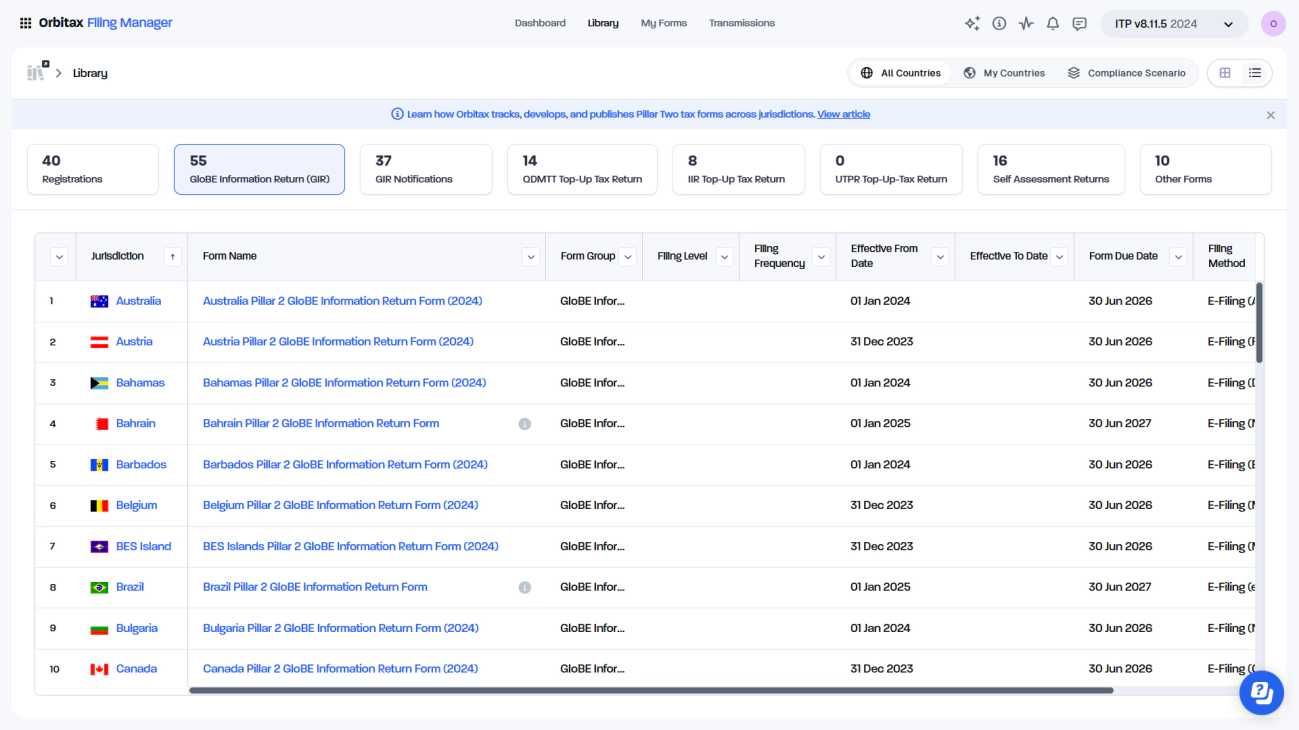
Beyond the FY 2024 cycle, the Filing Manager Library spans 55 jurisdictions, 8 form types, and over 180 Pillar Two forms. All 38 FY 2024 implementing jurisdictions have a GIR live in the platform with 100% coverage.
Placeholder forms: how Orbitax covers the 20 unpublished forms
The conventional approach in tax technology is to wait. A form is finalised, it gets digitised, it appears in the product. That forces tax teams into a binary in this cycle: either the form is in your tool, or you are scrambling manually when it lands weeks before the deadline.
Orbitax has taken a different position. For jurisdictions that have enacted Pillar Two for FY 2024 but have not yet published a local form, the platform includes placeholder coverage built from what publishing jurisdictions have typically required, so tax departments can get started and only have to make relatively small changes when the form is published.
Direct machine-to-machine filing, live now
Coverage is one half of filing readiness. Transmission is the other. Three jurisdictions have opened their tax authority portals for direct machine-to-machine submission of Pillar Two filings, and Orbitax has been certified or credentialed in each:
- United Kingdom: Orbitax has been issued submission credentials by HMRC and is listed as a recognised software supplier for Pillar 2 top-up taxes. UK returns, including the GloBE Information Return have already been accepted.
- Canada: Orbitax holds the credentials to transmit Pillar Two filings directly to the Canada Revenue Agency. GIRs, GIR Notifications have already been accepted.
- Netherlands: Orbitax is certified for the Dutch Tax Authorities’ portal, which opened on 1 June 2026. GIR filings have already been accepted.
- Germany: Orbitax holds the credentials to transmit Pillar Two filings directly to the BzSt and has successfully submitted multiple test filings.
Credentials for the remaining machine-to-machine jurisdictions (Australia and Hungary) are expected on a rolling basis ahead of the deadline. Manual transmission is supported throughout, with the same upstream preparation and validation.
From local calc to local filing in one workflow
The point of complete jurisdictional coverage is not the count of forms. It is that each step of the Pillar Two workflow resolves into the next without re-keying or reconciliation.
Local country calculators feed the OECD GloBE calculator. The OECD calculator feeds the GIR. The GIR populates the designated filing jurisdiction’s local GIR automatically, with Schedule 3 pulling source-tagged data that identifies whether each line came from the OECD or local country calculator. Where local forms exist, they are populated from the same dataset. Validation runs across the OECD’s three error categories (File, Severe Record, Other Record) and the XML schema, with XatBot on hand to interpret specific error codes and surface the underlying data issue. Filings move to tax authorities through the platform, manually or by direct e-file where supported.
Designed to keep pace with the OECD
The clearest test of whether a compliance stack can hold through the first filing season is whether it can absorb mid-season changes from the OECD without disrupting the work underneath.
On 18 May 2026, the OECD published its Common Understanding on GIR central filing for the 2024 reporting year, under which 33 implementing jurisdictions agree to waive penalties and local filing obligations where the GIR has been centrally filed in one of the listed jurisdictions by the deadline. The relief is provisional, with exchange relationships expected to be activated by 31 December 2026.
The Orbitax Pillar 2 Compliance grid now applies the Common Understanding by default across all 33 jurisdictions, with the carve-outs reflected automatically: jurisdictions that have not joined (Bahamas, North Macedonia, Slovak Republic, Vietnam), the conditional joiners (Greece and Poland, only for other EU members), and the date-restricted carve-out (Japan’s QIIR, from 1 April 2024). As further jurisdictions confirm their position, the grid updates.
This is the kind of motion that defines the first filing season, and the operating tempo Orbitax has been built to match.
And the season after this one
By the time the June 2026 deadline passes, FY 2025 calculations will already be in motion across many groups, against forms that will continue to be patched and guidance that will continue to evolve. The compliance stacks that close this filing season without an exception list are the ones that will handle the next without a rebuild.
The first Pillar Two filing season was always going to be the credibility test for global tax technology. Coverage that is mostly there leaves the work on the desk of the tax team. Coverage that is complete, including for the jurisdictions that have not finished implementing themselves, and proven through filings that authorities have already accepted, returns that work to where it belongs: review and judgment, not assembly.
Running behind? You can still make June 30
For groups that have not yet completed their Pillar Two implementation, the Orbitax Pillar 2 Compliance Accelerator takes a 1120 or CbCR XML and runs the full workflow: entity footprint mapping, transitional CbCR safe harbor logic, a filtered list of jurisdictional filing obligations, GIR population from OECD and local calculators, validation with XatBot assistance, and direct or manual transmission. The platform meets you wherever you are in the cycle.
See it for yourself
If you are evaluating your Pillar Two compliance stack ahead of the June 2026 deadline, book a demo of Orbitax Global Minimum Tax to see complete jurisdictional coverage, and proven filings, in action.
Already a GMT user? XatBot Pro+ is now free for Orbitax GMT users through the June 2026 filing season.